Spin the World Around began as a case for going alone. I still believe a solo trip is one of the simplest ways to meet a place, and I wrote about that in Why solo travel makes you more present. Two, though, is often the perfect number. A friend or a partner can make a trip more possible, and more companionable, than going alone or moving as a crowd.
Most organized travel is still priced for two people. All-inclusives, cruises, retreats, and many group trips assume a shared room. Go as a single and you often pay a supplement for using that room by yourself. The second person is, in practice, almost already paid for. If the plan involves an entire room rather than a spare couch, traveling as a pair can be the cheaper way, not the more extravagant one.
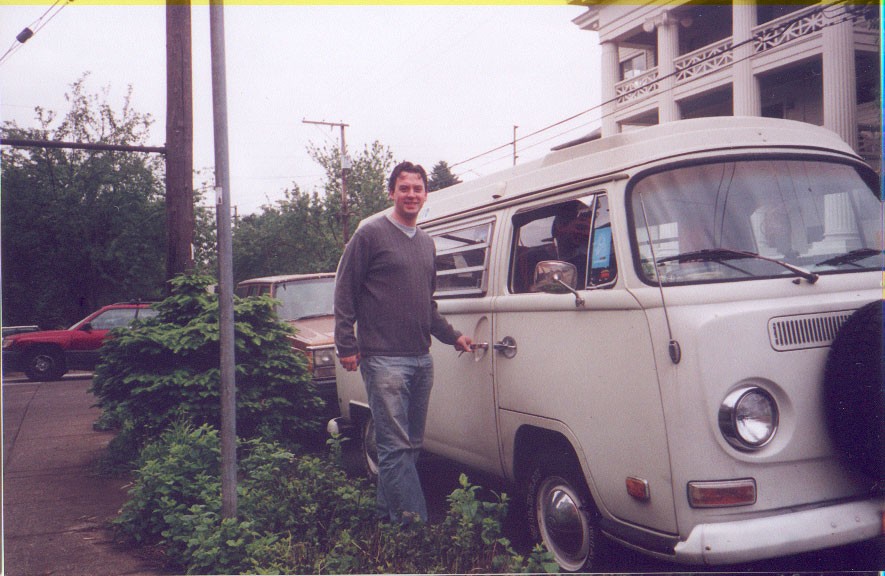
The same math holds on the road. Fuel, insurance, and the car itself cost the same with one person or two, so a second traveler cuts that in half and can share the driving. It also means you have a witness. Years later you will remind each other of things one of you would have lost. This photograph is from Portland, in 2005, when a friend named Cougar picked us up in his 1970 Volkswagen bus and drove us around the city. The trip would have been a different story without him in it.
A travel partner is also a safety valve. Not a babysitter. Just another set of eyes when a situation feels off, and someone who can help you leave when it is time to leave.
Company changes the social work of a trip, too. When I traveled alone around the world, the lonely stretches were real, and I filled them by sitting quietly or by going to meet someone new. With a person you already get along with, you don’t have to hunt for a conversation at the end of every day. That can be a gift, and it can also become a small island if you never look up from each other. Two is still a number that can meet a local or join a table without turning into a closed circle.
There is also no rule that you have to spend every hour together. Once you have a home base, you can take a solo trip inside the trip: an afternoon apart, each of you doing the thing the other would only tolerate, then a meal where you actually have something new to tell each other. I wrote more about that kind of solitude in A night to yourself.
It helps to be clear, before you leave, about what the trip is. Travel makes quick, deep memories, and both people should have the same picture of the relationship that is making them. If one person is paying, say what that does and does not include. If you mean the trip to be platonic, say so at home, not in a room with one bed after a long flight. The point is to keep someone from arriving with a story the other person never agreed to, in a place where neither of you can easily step away.